Budget 2026: What It Means for Your Child's School
Budget 2026 puts $2 billion into education, lifts school operating grants, funds school lunches into 2027, and confirms NCEA's replacement.
By BoundFor Team
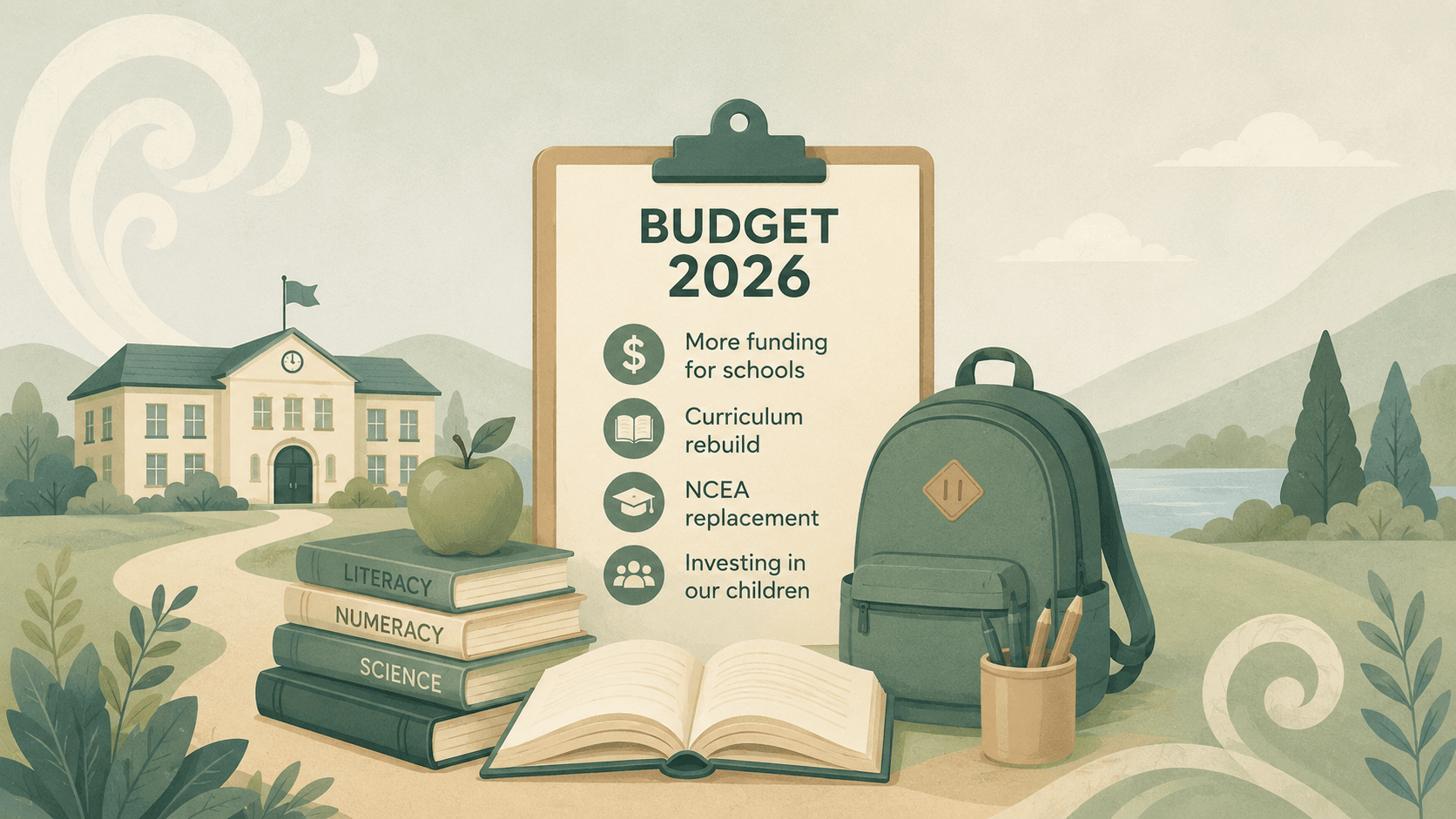
On 28 May the Government handed down Budget 2026. Education gets just over $2 billion of new operating funding over the next four years, including tertiary, plus $501 million of capital. Three things stand out for families: schools get more day-to-day funding, the school lunch programme is funded for another year, and the qualification your teenager works toward is being replaced.
This piece skips the politics and sticks to the parts that touch your child's school. If you want the bigger picture of how school funding works in the first place, our Equity Index guide is the place to start. Here's what changed on Budget day, and what it means for your family.
Quick facts
- Just over $2 billion in new operating funding for education over four years, including tertiary, plus $501 million of capital (Budget 2026, announced 28 May 2026)
- $160.4 million more for school operating grants (roughly a 2% lift), supporting about 856,400 school-aged children
- $470 million of capital to redevelop up to 10 schools, add up to 232 classrooms and buy land for new ones
- NCEA is being replaced from 2028 by the NZCE (Year 12) and NZACE (Year 13), with a new Year 11 Foundational Award
- $131 million for reading, writing and maths in primary and intermediate schools
- $212 million to keep the Healthy School Lunches and early learning food programmes running in 2027
What's actually new for schools
Every state and state-integrated school gets an operating grant, the money that pays for the day-to-day running of the school. Budget 2026 lifts that grant by $160.4 million, which the Ministry of Education says works out to about a 2% increase. It goes toward staffing, curriculum delivery and the ordinary costs of keeping the lights on: heat, water, repairs and support staff.
Alongside that sits $470 million of capital to redevelop up to 10 schools, deliver up to 232 extra classrooms and buy land for new schools. That won't change your child's classroom next term, but it's the pipeline that decides whether a growing school gets the rooms it needs.
The honest read on the operating grant: this is a cost-pressure top-up, not a transformation. It helps schools keep pace with rising costs rather than do something new.
The big one for secondary families: NCEA is being replaced
If your child is in or heading toward secondary school, this is the change to pay attention to. The Government has confirmed it will replace NCEA, the qualification New Zealand teenagers have worked toward since 2002, with a new system that starts in 2028. Two new certificates sit at the top: the New Zealand Certificate of Education (NZCE) at Year 12, and the New Zealand Advanced Certificate of Education (NZACE) at Year 13. Below them is a new Foundational Award in literacy and numeracy, benchmarked at Year 11 and usually sat that year.
Budget 2026 puts $74 million into the rollout: building the refreshed New Zealand Curriculum and the new qualifications, and the resources and teacher training behind them.
The change phases in over three years. The Foundational Award comes first, in 2028 — the same year Science joins English and maths as a compulsory Year 11 subject. NZCE follows in 2029 and NZACE in 2030. If your child is partway through NCEA now, the work they've already done still counts. If they're in primary or intermediate, they're more likely to be among the first to sit the new qualifications, so it's worth checking where your child's year group lands.
Primary and intermediate: back-to-basics funding
For younger kids, the headline is a $131 million package the Government calls "Teaching the Basics Brilliantly", aimed at reading, writing and maths in primary and intermediate schools. It pays for the resources and teacher support behind structured literacy and numeracy.
For parents, this won't look like a new building or a new subject. It shows up in how reading and maths are taught: the materials in the classroom and the training the teacher has had behind them.
School lunches keep running, for 2027
One line in this Budget matters to a lot of families: $212 million to keep the Healthy School Lunches and early learning food programmes going through 2027. The lunch programme is targeted at schools serving communities with the most socio-economic need, which is where it overlaps with the Equity Index — higher-need schools are the ones most likely to be in it. If your child's school provides lunches, this is the funding that keeps them on the table next year. Whether the programme continues past 2027 is a decision for a future Budget.
Trades, youth training and early learning
A few other lines matter depending on your child's age. Trades Academy places, where senior students train in a trade while still at school, double to 20,000 for Year 11 to 13 students, funded by $69 million. Another $87 million funds 1,000 more Youth Guarantee places, free learning for young people with no or low qualifications. Early learning subsidy rates also rise. Much of this vocational push is paid for by ending final-year Fees Free at the end of 2026, which saves the Government just over $1 billion.
How this connects to the funding you already see
Two pots of money here sound alike but do different jobs. The operating grant in this Budget is the general grant every school gets. It is not the same as equity funding, the extra money a school receives based on its Equity Index (EQI), the number that reflects the barriers its students face. Budget 2026 didn't change how the EQI works or how equity funding is calculated.
So if you're comparing schools, this Budget doesn't move the dial on the data you'd use to do it. A school's EQI, its roll and its ERO report are all unchanged by Budget day. The funding helps schools keep up with costs and keeps some programmes running; it doesn't tell you anything new about which school is right for your child.
- Does Budget 2026 change my school's EQI or decile?
No. The Equity Index isn't affected by this Budget. The EQI is recalculated every year using Stats NZ data about the students enrolled, and Budget 2026 didn't change that process. Deciles were already replaced by the EQI back in January 2023.
- When does NCEA actually change for my child?
The new system starts in 2028 and phases in over three years: the Year 11 Foundational Award in 2028, NZCE in 2029, and NZACE in 2030. Students partway through NCEA keep the credits they've earned. Check where your child's year group lands, since that decides which qualification they'll sit.
- Will my child still get free school lunches?
If your child's school is in the Healthy School Lunches programme, yes. Budget 2026 funds the programme through 2027. It's targeted at schools serving communities with the most socio-economic need. Whether it runs beyond 2027 is a decision for a future Budget.
- Will the bigger operating grant mean lower school donations?
Not necessarily. The $160.4 million is a general top-up to help schools meet rising costs, not a replacement for donations. The separate donations scheme, which pays schools at an EQI of 432 or higher to stop requesting donations, is unchanged by this Budget.
- Is my teenager's NCEA still worth anything?
Yes. NCEA remains a recognised qualification, and credits already earned still count. The replacement is being introduced over time, not applied retroactively.
What should I do next?
- Find out where your child's year group lands in the NCEA-to-NZCE timeline. Your school office will know how the change applies to your child specifically.
- Keep using the data that didn't change. A school's EQI, its roll trend and its ERO report still tell you far more about fit than any Budget line. Compare schools on BoundFor.
- Ask your school how it's spending the basics funding if you've got a child in primary or intermediate — it's a fair question at the next parent evening.
More in school funding
- Understanding the Equity Index (EQI): What Every Parent Needs to Know
- What Does My School's EQI Actually Mean for My Child?
Stay updated
Get new articles about NZ schools delivered to your inbox.