Starting School in New Zealand: Stationery Packs and What Your Child Actually Needs
A plain checklist for the first day of primary school in New Zealand — what a stationery pack is, what the school provides, and what you can safely skip.
By BoundFor Team
Most of what we write at BoundFor is about choosing the school. This piece is about the fortnight after you've chosen it.
You've got a place. Your child turns five soon. Now there's a stationery list in your inbox, a uniform shop with odd hours, and a small person who wants to know if they can bring their toy dinosaur. This is a plain guide to what a child starting primary school in Aotearoa actually needs on day one — what to buy, what the school hands over, and what you can leave on the shelf.
Quick facts
- Children can usually start after they turn five, and must be enrolled by the time they turn six. Some schools use cohort entry, so a child may start on a set date rather than on their birthday.
- A new entrant stationery pack is often around $30 to $75, though some lists are cheaper and some can run higher.
- Stationery is optional. You can buy the school's pack or the same items anywhere you like.
- Ka Ora, Ka Ako offers a free daily lunch at eligible schools and kura, selected using the Equity Index to reach the students with the highest need.
- SunSmart-accredited schools require a sun hat in Terms 1 and 4 — no hat, play in the shade.
- No single item is dear. The squeeze comes from adding them all up.
What a stationery pack actually is
A stationery pack is the whole list, bundled. Instead of hunting down "one 1B8 exercise book, two HB pencils, a glue stick," you order a box with the exact books, pencils and bits the teacher asked for, and it turns up sorted.
Most schools run this through a supplier. OfficeMax's MySchool, School Depot, Schoolpacks, Onehunga Books & Stationery and Paper Plus are the common ones. You look up your school, pick the new entrant or Year 1 list, and pay.
A new entrant pack is smaller than you'd think. It's usually a handful of named exercise books, HB pencils, a set of coloured pencils or crayons, a glue stick, blunt scissors, a couple of whiteboard markers, a clearfile or two, and a book bag for the reading folder that travels home each night. Some lists add a personal dictionary or a set of headphones. One or two even include the school bucket hat.
That's it. A five-year-old writes with a pencil and reads a little book. The kit matches the job.
Do you have to buy the school's pack?
Honest answer: no. Stationery is what the Ministry of Education calls an optional good. You can buy the pack from the school's supplier because it's easy, or you can take the list to any shop and buy the same things yourself.
The only real advantage of the pack is that it matches. You get the exact exercise book sizes and pencil brands the teacher wants, without decoding "1F4" in aisle three. If your budget is tighter than your time, the same list buys just as well at The Warehouse or Kmart.
Worth asking the office: whether they want the pack bought through their supplier, or whether bringing your own is fine. Most schools are relaxed about it.
What the school provides, and where your Equity Index quietly comes in
Some of what your child needs, the school hands over. Two things in particular depend on your school's Equity Index, the measure that estimates how many socio-economic barriers a school's students face on average. We wrote a whole guide to the Equity Index if the term is new to you.
The first is lunch. Ka Ora, Ka Ako, the healthy school lunches programme, provides lunches at eligible schools and kura, selected using the Equity Index to reach the students with the highest level of need. At those schools every child is offered a free lunch every school day, whether or not they brought one. In 2026 the programme reaches more than a thousand schools and over 240,000 students. If your school is in it, you may not need to pack a lunch at all. If it isn't, you will.
The second is donations. State or state-integrated schools with an Equity Index of 432 or above can join the donations scheme. In 2026 they receive about $166 per student from the government and agree not to ask families for a donation, overnight camps aside. Even those schools can still ask you to buy stationery, because stationery sits outside the scheme.
The through-line is this: at state schools, domestic students get free enrolment and free education. State-integrated schools may charge compulsory attendance dues, donations are voluntary, and stationery is optional either way. What you actually have to spend depends a fair bit on which school your child walks into.
The rest of the day-one kit
Stationery is the part with a list. The rest is the stuff nobody emails you about.
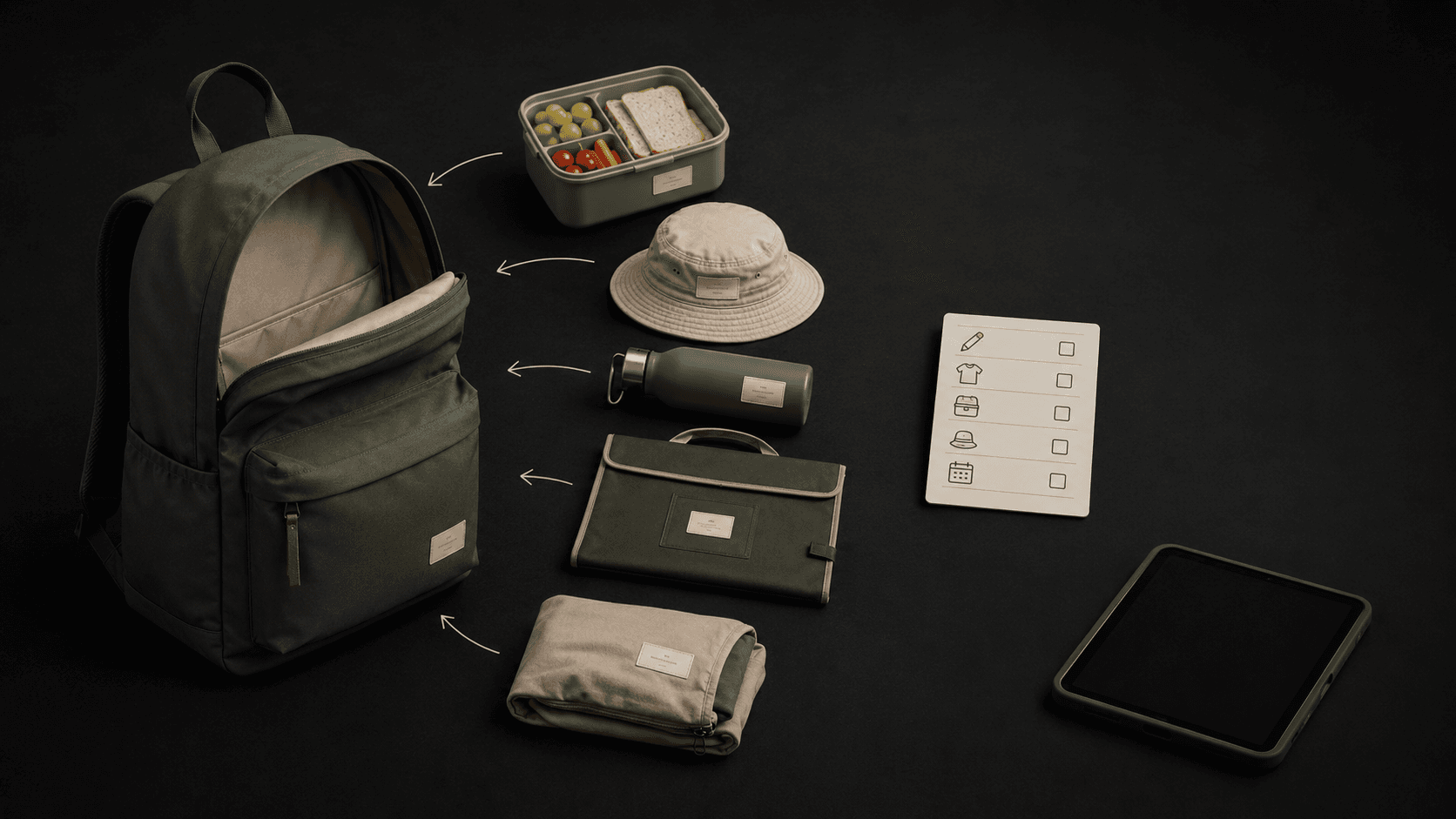
A backpack big enough to hold an A4 book bag, a lunchbox and a drink bottle, and small enough for a five-year-old to carry. A lunchbox and a water bottle, unless your school does lunches. Covered shoes they can run in. For the littlest ones, a spare change of clothes in the bag, because accidents happen in the first few weeks.
Then the hat. New Zealand's UV is unusually strong, around 40% higher than countries at similar latitudes in the Northern Hemisphere, so hat rules are worth taking seriously. SunSmart-accredited schools are expected to require broad-brimmed, bucket or legionnaire-style hats in Terms 1 and 4, or whenever UV levels are high. A cap usually isn't enough, because it leaves the ears, neck and sides of the face exposed. The rule at most schools is simple: no hat, play in the shade.
Check whether the school has a uniform or runs mufti, and whether there's a second-hand uniform shop. Most do, and it's where the real savings are.
One piece of advice that sounds trivial and isn't: name everything. The hat, the drink bottle, both shoes, the jersey, the lunchbox lid. A classroom of new entrants generates a lost-property pile the size of a small car by week two, and a named item comes home.
What you can skip
Buy to the list, not to the marketing.
A new entrant does not need their own device. Don't buy one unless the school's list specifically asks for it. Bring-your-own-device (BYOD) rules vary by school and are usually more relevant for older students, and Year 1 learning runs on pencils and picture books.
You also don't need the extras the teacher didn't ask for. A giant art set, a branded pencil case with matching everything, a second backpack "for spare" — none of it makes the first day go better. Budget stationery and premium stationery both get chewed, lost and outgrown at the same rate.
The list exists because the teacher knows what the classroom uses. Trust it, and stop there.
A note on the cost
No single thing on this page is expensive. A pack is thirty-odd dollars, a hat a bit less, a drink bottle less again. The reason back-to-school lands hard is that it all arrives in the same fortnight, often alongside a uniform that can run several hundred dollars for the first full set.
That cumulative squeeze is real and well documented. In the March 2025 quarter, the Ministry of Social Development's figures show Special Needs Grants for school education costs sitting roughly in the $9 to $10 million range, a sign of how much back-to-school costs can weigh on families. If money is tight, a few things genuinely help: buy the uniform second-hand, buy stationery to the list rather than above it, spread the shop across a couple of pays, and ask the office what support is available. Schools would far rather have that conversation quietly than have a child turn up short.
Questions to ask the school office
Before day one, a five-minute call clears up most of it:
- Do we buy the stationery pack through you, or can we bring our own?
- Is there a uniform, and do you have a second-hand shop?
- Are you part of the free school lunches programme, or should I pack lunch?
- What's your sun hat rule, and do you sell the school hat?
- Do you use continuous or cohort entry, and what's my child's exact start date?
FAQ
- How much should I budget for a child starting school?
For the basics — a stationery pack, a hat, a lunchbox and drink bottle, and a backpack — plan for somewhere around $80 to $150. A uniform is the big variable on top of that; a first full set for primary can run to a few hundred dollars, which is why second-hand shops are worth finding. Lunches are free at schools in the Ka Ora, Ka Ako programme.
- Do I have to buy the stationery pack from the school?
No. Stationery is an optional good, so you can buy the school's pack for convenience or buy the same items yourself anywhere. The pack's only real advantage is that the book sizes and brands match exactly what the teacher asked for.
- What should I write my child's name on?
Everything that leaves the house. Hat, drink bottle, lunchbox, both shoes, jersey, bag and book bag. New entrant classrooms lose things at a heroic rate, and a named item finds its way back.
- My child turns five mid-term. When can they start?
It depends on whether the school uses continuous or cohort entry. With continuous entry your child can start any day after they turn five. With cohort entry they start on one of eight set dates through the year, at the beginning and middle of each term. Either way, a child must be enrolled by their sixth birthday. Ask the office which system they use.
- Does my child need their own iPad or laptop in Year 1?
Almost never. Bring-your-own-device rules vary by school and are usually more relevant for older students. If a device isn't on the stationery list, your new entrant doesn't need one.
What should I do next?
- Find your school and its office details on BoundFor's explore tool.
- Ask for the new entrant stationery list, and whether there's a pack to buy or you bring your own.
- Check the uniform, hat and lunch situation, including whether the school is in the free lunches programme.
- The night before, lay it all out and name everything.
If you're still weighing up schools rather than packing a bag, that decision matters more than any stationery list. Our guides to the Equity Index and what your school's EQI means for your child are a good place to start. And if you'd like the full picture on a specific school in one place — its Equity Index, zone and the rest, without piecing it together yourself — a BoundFor school report does that legwork for you.
More from BoundFor
- Understanding the Equity Index (EQI): What Every Parent Needs to Know
- What Does My School's EQI Actually Mean for My Child?
Stay updated
Get new articles about NZ schools delivered to your inbox.