What Does 'Year 0' Mean? New Intake and Starting School in New Zealand, Explained
Year 0 isn't a missing year or a setback — it's how NZ schools record children starting mid-year. What it means, and how cohort entry works.
By BoundFor Team
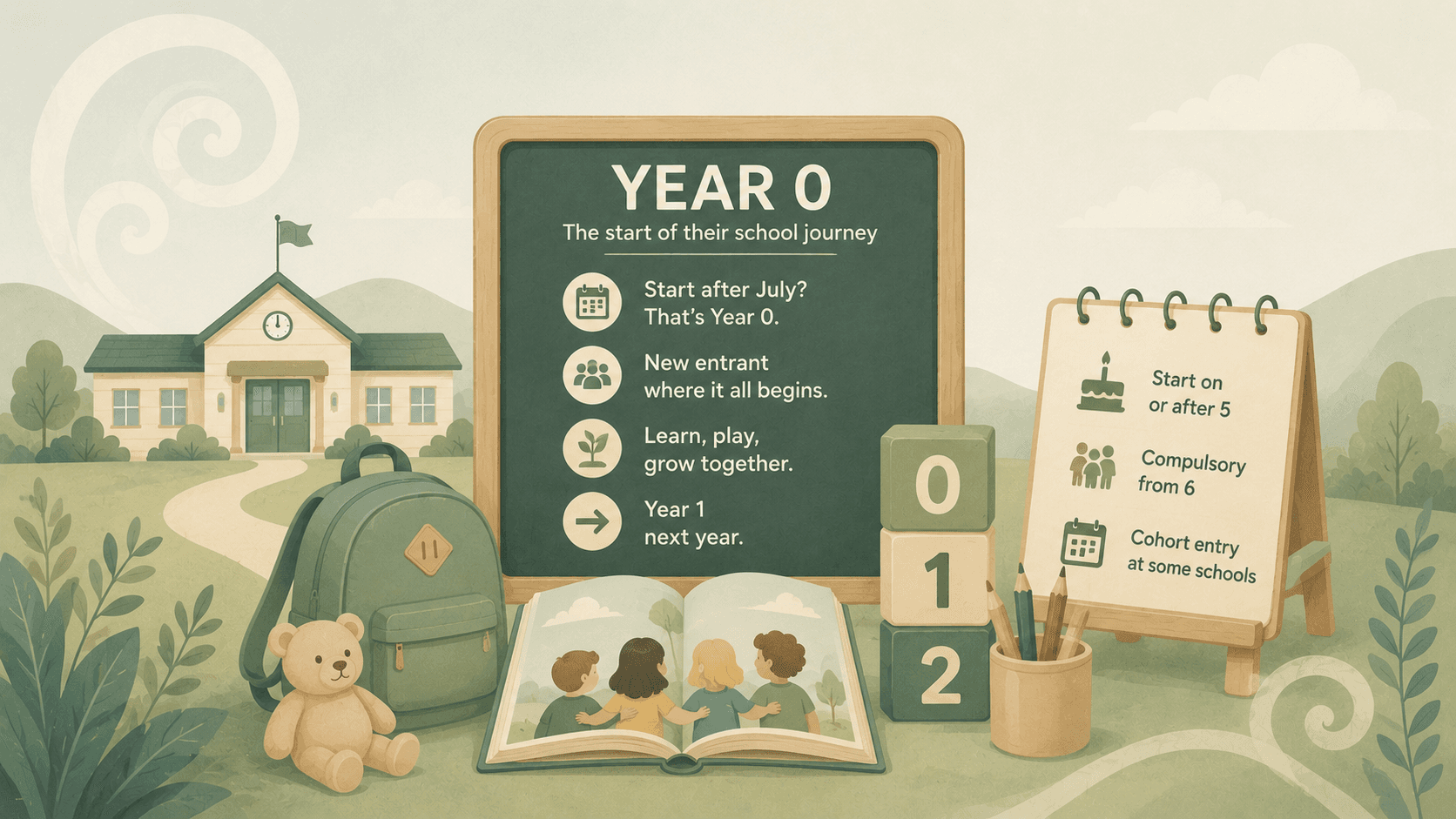
Among the new terms that come with starting school, "Year 0" is one of the most misread. It sounds like a missing year or a setback, when it's neither — it's simply how schools record children who start in the second half of the year.
This article covers what Year 0 means, when your child can start school, the difference between a "new entrant" and a "Year 0", and how cohort entry works at the schools that use it. The aim is a clear picture of the first term, without the jargon getting in the way.
Quick facts
- The New Zealand school year runs from January to December, split into four terms.
- New Zealand school is from Year 0 to Year 13. Year 0 is the very start, Year 13 is the final year of secondary school.
- Most children start school on or shortly after their fifth birthday. You can apply (pre-enrol) before then, but they can't be enrolled or attend until they turn 5.
- School is compulsory from age 6. Free state education runs from age 5 to 19.
- Year 0 just means your child started in the second half of the year — roughly July onward. They roll into Year 1 the next year.
- "New entrant" is the everyday word for any child in their first weeks at school, whether they're recorded as Year 0 or Year 1.
- Some schools use cohort entry: new children start in groups on set dates, rather than one at a time on their birthdays.
What does "Year 0" actually mean?
Year 0 is a roll classification, not a school report. It tells the Ministry of Education (MoE) when your child first started school, which the Ministry uses to count students for funding and staffing. It says nothing about how your child is doing.
Here's the rule underneath it. Schools count their roll in July each year. A child who starts school for the first time before that July count is recorded as Year 1 for the year. A child who starts after it — roughly the second half of the year — is recorded as Year 0, and then becomes Year 1 at the start of the next year.
So a child who walks in the door in February is a Year 1. A child who starts in August is a Year 0, and becomes a Year 1 the following January. Same age, same class in many cases, different label, purely because of the date they started.
One thing worth knowing: the exact cut-off can vary. The July roll count is the national reference point, but some schools set their own cut-off date, and others decide in conversation with the parent. Term 1 starters are almost always Year 1, and Term 3 starters are almost always Year 0. It's the middle of the year where it's worth asking the school directly.
When can my child start school?
Most children start on or just after their fifth birthday. You can apply to a school before your child turns 5 so the place is ready. This is called pre-enrolment. The law does not allow a child under 5 to be enrolled at a primary school, so your child is enrolled and starts attending from the day they turn 5 or later.
School becomes compulsory at age 6. From their sixth birthday, a child in New Zealand must either be enrolled at a school or formally home-educated. That gives most families a window of up to a year to decide exactly when to start, somewhere between the fifth and sixth birthday.
For New Zealand citizens and permanent residents, enrolment and education at a state school are free between the ages of 5 and 19. If your child lives inside a school's home zone, or the school has no enrolment scheme, the school has to accept your enrolment.
Year 0, new entrant — what's the difference?
People use these words as if they mean the same thing, and most of the time it doesn't matter. But they're not quite the same.
New entrant is the everyday term for any child in their first stretch at school: the new-entrant classroom, the new-entrant teacher. It's about being new, not about a year number. A child is a new entrant whether they're recorded as Year 0 or Year 1.
Year 0 is the formal roll classification for a child who started in the second half of the year. It's the word that shows up in official systems, not usually the word the teacher uses with you at the gate.
The practical version: if the school calls your child a new entrant and the paperwork says Year 0, both are correct. One is describing the classroom, the other is describing the calendar.
What is cohort entry?
Traditionally, New Zealand children have started school one at a time, on or shortly after their fifth birthday. Many still do. But some schools now use cohort entry, where new children start together in groups on set dates instead.
At a cohort-entry school, there are 8 set start dates across the year, one at the beginning and one in the middle of each term. The Minister of Education sets these dates, and schools using cohort entry can't change them. Once your child turns 5, you choose the next available date that suits; they still can't start before turning 5, and must start by the time they turn 6.
The thinking behind it is about settling in. The Ministry and the Education Review Office (ERO) point to children feeling less anxious and finding their feet faster when they walk in alongside a group of other new kids, rather than joining an established class on their own. The trade-off is less flexibility on the exact start day.
Not every school uses cohort entry, so this is worth checking when you enrol. Ask the school directly, or look up the school's listing on Education Counts. BoundFor's term dates page is a useful companion for lining up where those start dates fall.
Does starting as Year 0 set my child back?
No. This is the worry underneath the question, so it's worth being plain about it.
Year 0 is not repeating a year, and it's not a sign anyone thinks your child is behind. It's a bookkeeping label tied to a date. If anything, it works in your child's favour at the start. A child who starts in August does a term or two recorded as Year 0, then gets a full year recorded as Year 1. A child who started the previous February does part of a year as Year 1, then moves up to Year 2. The late-year starter isn't losing time; they're getting a fuller run at Year 1 before the numbers tick over.
What actually shapes your child's first year is the ordinary stuff: the teacher, the classroom, the friends they make, and how the school eases new kids in. The new-entrant year in most schools looks a lot like the play-based learning your child already knows from early childhood, with school routines layered in gently. The label on the roll doesn't change any of that.
Where new entrants go from here
Once your child is past the new-entrant stage, the path depends on the type of primary school they're at. Two common types take new entrants, and they cover different stretches of primary.
A contributing primary runs from Year 1 to Year 6, then children move on to an intermediate for Years 7 and 8 before secondary school.
A full primary runs from Year 1 all the way to Year 8, so children stay at the same school through the intermediate years rather than changing at Year 7.
Neither is better as a rule. It comes down to how many school changes you'd prefer in your child's early years, and which schools sit in or near your zone. That's the point where the rest of your research starts, and where a school's Equity Index and ERO report start to matter more than the Year 0 label ever will.
- Is Year 0 the same as repeating a year?
No. Year 0 is a roll classification for children who started school in the second half of the year. They move into Year 1 the following year. It has nothing to do with your child's progress or being held back.
- My child started in February — why are they Year 1, not Year 0?
Because they started before the July roll count. Children who begin in the first half of the year are usually recorded as Year 1, and children who begin in the second half are recorded as Year 0. It comes down to the start date, not age.
- Does my child have to start school on their fifth birthday?
No. Most children start on or shortly after turning 5, but you have until their sixth birthday, when school becomes compulsory. At a cohort-entry school, your child starts on the next set date after they turn 5.
- What is cohort entry?
It's when a school starts new children in groups on set dates, rather than one at a time on their birthdays. There are 8 set dates a year, set by the Minister of Education. Not every school uses it, so check with the school when you enrol.
- What's the difference between a new entrant and a Year 0?
"New entrant" describes any child in their first stretch at school, whatever their year number. "Year 0" is the formal classification for a child who started in the second half of the year. A child can be both at once.
What should I do next?
The Year 0 question is usually the first of many, and the good news is it's the easiest one to put to rest. Once you know the label is just a date, you can move on to the choices that actually shape your child's schooling.
- Confirm the start details with your school. Ask whether they use cohort entry, and what their cut-off is for Year 0 versus Year 1 if your child is starting mid-year.
- Check the type of school and its zone. Knowing whether it's a contributing or full primary tells you when the next school change will come. Use Explore to see schools near you.
- Read the school in context. A school's Equity Index and ERO report tell you far more about the community and the school than any year-level label.
- Visit. Walk the grounds, meet the new-entrant teacher, and get a feel for how they settle new kids in.
More in choosing a school
- Understanding the Equity Index (EQI): What Every Parent Needs to Know
- What Does My School's EQI Actually Mean for My Child?
See how these schools fit your family
A BoundFor report puts your address on each zone map, plans the school run, lays your shortlist side by side with ERO key findings in the review's words, and gives you questions to ask on a visit.
About the author
BoundFor Team
BoundFor research team
The BoundFor team curates and verifies New Zealand school information using public ERO and MoE data.
More from BoundFor Team →Stay updated
Get new articles about NZ schools delivered to your inbox.